Notable features
import entrainment
Seasonal dilation
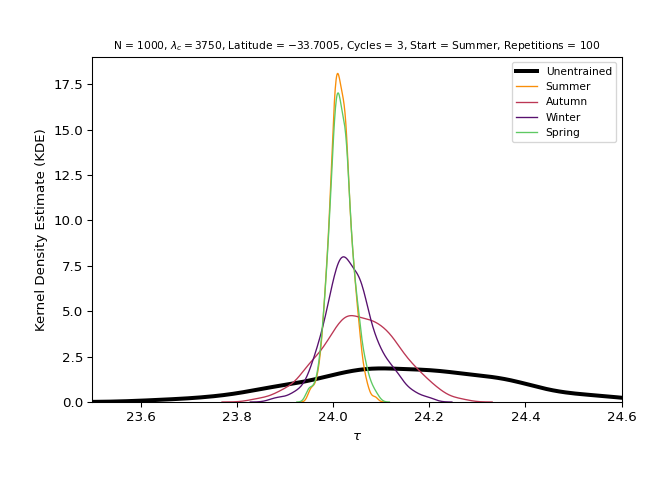
turtles = entrainment.run_model(labren_id = 1, by = "season")
Flattening
Due to the axis of rotation and the translational movement of the Earth, there is a high intensity of solar irradiation in the summer at latitudes close to the tropics, which causes these populations to adapt their periods to a greater extent when compared to populations close to the line from the equator. In terms of the annual average, with the exception of populations very close to the poles, solar irradiation is almost the same, since the deficit of solar radiation in winter that tropical populations may have is compensated by the increase in solar radiation that these same populations have in summer. This causes them to differ very little when grouped in this way. Therefore, as shown in the previous section, that the latitude hypothesis is more present at certain times of the year and that different resolutions in the analysis of this phenomenon can bring contrasting results.
x = entrainment.run_model(labren_id = 72272, by = "year", plot = False)
y = entrainment.run_model(labren_id = 1, by = "year", plot = False)
entrainment.plot_model_line_1_2(x, y)

Graduation
Another notable feature of the model is the gradual adaptation of periods.
This dynamic is not trivial. The sequence/order of photoperiods appears to bring about a significant difference in the distribution of circadian periods at each step. Therefore, even if a population is subjected to a strong solar zeitgeber at a given moment, the distribution of periods will always depend on its starting point. In other words, two populations subjected to the same solar zeitgeber may present different period distributions due to the exposures to which they were previously submitted.
This can be observed in the model by subjecting populations with the same insolation pattern but with cycles ordered differently.
n = 10**3
lam_c = 3750
labren_id = 1
by = "season"
n_cycles = 3
repetitions = 10**2

x = entrainment.run_model(
    n = n, lam_c = lam_c, labren_id = labren_id, by = by, n_cycles = n_cycles,
    start_at = 0, repetitions = repetitions, plot = False
    )

y = entrainment.run_model(
    n = n, lam_c = lam_c, labren_id = labren_id, by = by, n_cycles = n_cycles,
    start_at = 2, repetitions = repetitions, plot = False
    )
entrainment.plot_model_line_1_2(
    x, y, x_title = "Starting on Summer", y_title = "Starting on Winter"
    )
